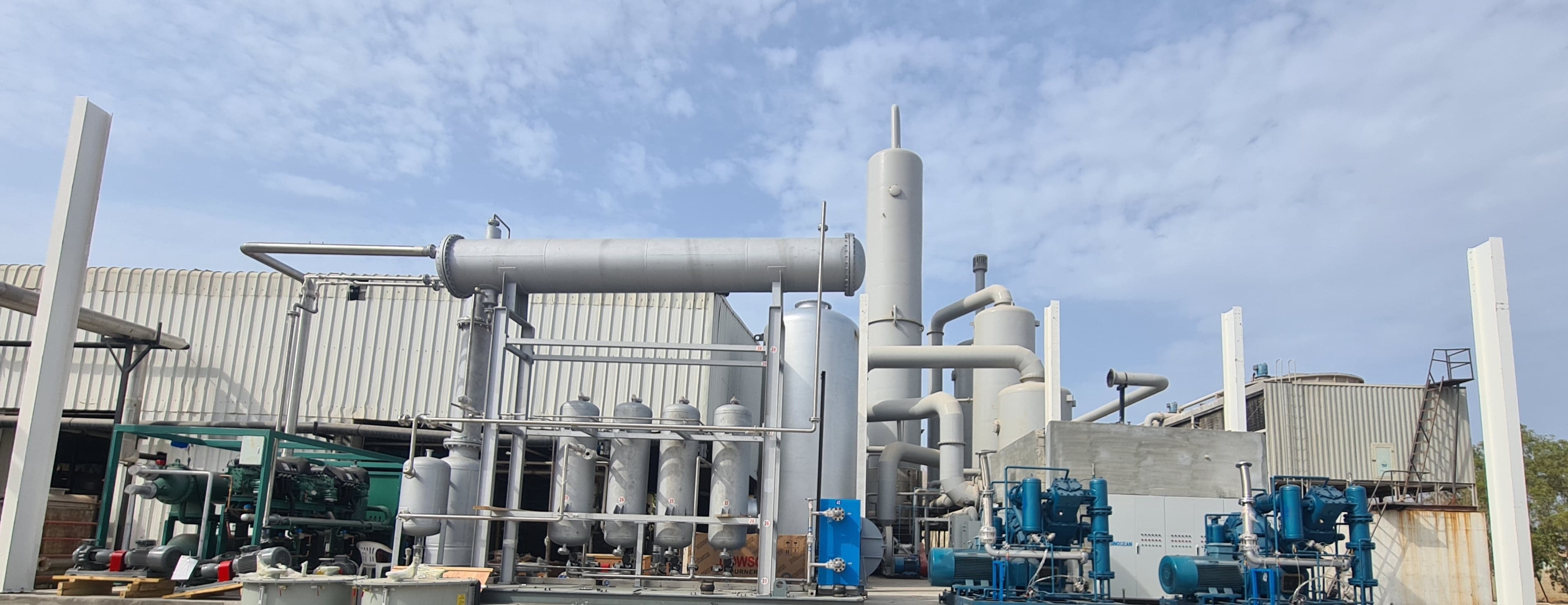
CO2 production plant process
How to produce Food grade LCO2 from burning diesel ?
The CO2 generating unit (CBU) is based on the combustion of various fossil fuels such as diesel, natural gas, LPG, heavy oil, coal, or even wood. Fuel burning-based CO2 production plants are welcomed by the customers from Africa, Middle East, and Latin America where liquid CO2 supply is not sufficient and cannot meet the local increasing demand for liquid CO2.
CO2 production process
CO2 Generating Plants are based on the absorption of CO2 from the flue gas arising from fuel burning into a monoethanolamine (MEA) based solution, which is heated by the fired boiler to release the CO2 gas again.
The plant is based on the combustion of fuel in an MEA heater equipped with a burner. After the combustion, the flue gas will have a CO2 content of 10% v/v around with temperature of approximately 250 °C.
The flue gas is directed to a flue gas scrubber, in which the gas is cooled and water condensed. Any SO2 present in the flue gas will be removed by means of a chemical reaction with sodium carbonate which is automatically added to the scrubbing water.
After that, the flue gas is sent to the primary absorption tower through the high-pressure fan and is absorbed by the MEA in the primary absorption tower. The CO2 in the residual flue gas enters the secondary absorption tower to absorb the remaining CO2 completely. The unabsorbed gas (O2, N2) ) Is discharged into the atmosphere.
Then the saturated MEA solution is pumped to a stripper, where the CO2 is released from the MEA solution utilizing the combustion heat generated in the MEA heater. The CO2-depleted MEA solution (referred to as lean MEA solution) is recycled to the absorber. After exiting the top of the stripper, the CO2-rich gas is cooled in a gas cooler and washed in an after-scrubber for removal of potential MEA carry-over. The gas is then compressed in two stages to approx. 18-20 bar(g) by the CO2 compressor.
Before liquefaction, the gas enters a freeze dryer first and gas outlet temperature is 2~4℃. Then it enters the dryer, in which the gas is dried to a dew point of below -60 °C. the cold-dried gas will enter the activated carbon adsorber to further remove organic impurities and odors. The work and regeneration of the activated carbon adsorber are controlled by PLC. Regeneration is done automatically by electrical heating and the use of dry purge gas from the CO2 condenser. The CO2 gas then passes through an activated carbon filter for the removal of any odor substances.
The CO2 liquefaction system is composed of CO2 evaporative condenser and Freon R507A condensing unit. The CO2 gas after deep drying will be liquefied at low temperature (-18℃) in the CO2 evaporative condenser, and the gas phase impurities (N 2.O2) will be discharged as non-condensable gas during the process of CO2 liquefaction and removal.
The liquefied CO2 liquid flows into the purification tower to form a liquid film and conduct mass transfer with the high-purity gas vaporized in the reboiler, achieving the purpose of liquid purification. The purified liquid CO2 is stored in the reboiler. When the carbon dioxide liquid reaches a certain level, it is automatically transported to the liquid storage tank by the variable frequency shielded pump. The liquid storage tank system is equipped with automatic, safe venting, liquid level display and other subsystems, with good reliability.
The final LCO2 product fulfil quality standards as a food/beverage ingredient as specified by International Society of Beverage Technologists (ISBT).
SINOCEAN CO2 Self-generating Plant Standard Sizes (measured as liquid food-grade CO2 produced): 50 kgs/hr, 100kgs/hr, 200kgs/hr, 300kgs/hr, 500kgs/hr, 1000kgs/hr, 2000kgs/hr. Other sizes are available on request.