
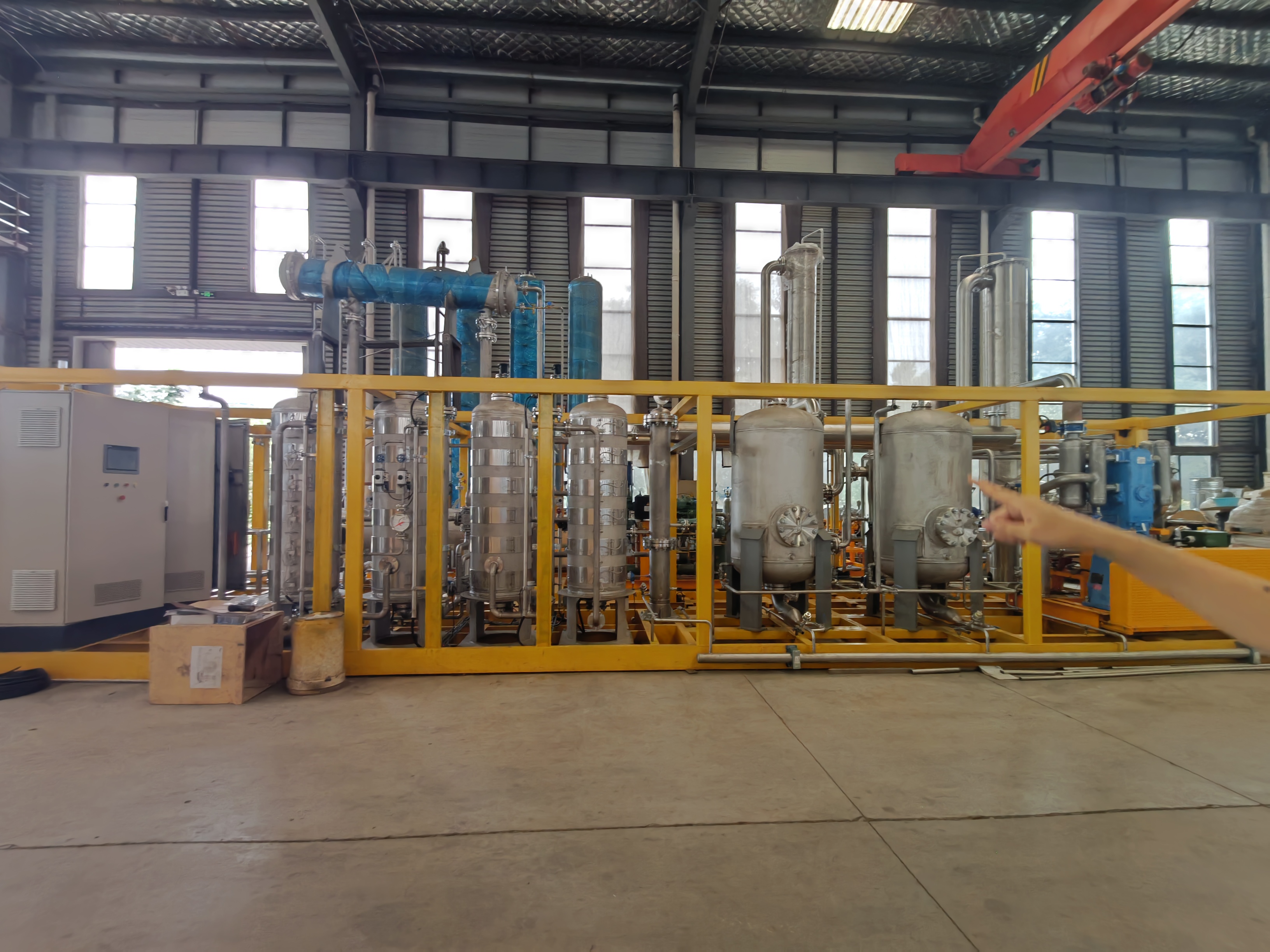
Brewery CO2 recovery plant with Mehrer CO2 compressors
2025-07-15
SINOCEAN offers first-class quality CO2 recovery plant from fermentation processes at 24/7 operating breweries
- liquid CO2 is one of the main food additives in the beer production process. The product quality of CO2 directly affects the quality and taste of beer! The quality of liquid CO2 produced by SINOCEAN carbon dioxide recovery device must fully reflect the original taste and mellow taste of brand beer.
- Taking into full consideration the concepts of safety and environmental protection, a regeneration gas recovery system is specially designed; at the same time, from the perspective of food safety, try to avoid the food safety risks of purchasing CO2, so try to collect as much as possible to avoid and reduce the production and operation costs of purchasing CO2 that may exist in the later stage of the manufacturer.
- Taking into account the production characteristics of beer companies, in terms of compressor configuration, we fully consider the off-season and peak season and the temperament of conventional beer fermentation, and are equipped with 2 small-displacement compressors. The recovery flexibility meets the needs of 30%-115% multi-level production capacity adjustment: a single compressor can meet the minimum recovery volume of 300-500kg/Hr, and the maximum recovery volume ≥550%/Hr; two compressors running at the same time meet the design needs of ≥1000kg/hr to 1100kg/hr.
- As a beer enterprise, safe production is the first factor, so the refrigerant uses environmentally friendly Freon R507.
- All compressors, refrigerators, instruments, and meter brands are domestic and foreign top brands to ensure that the equipment is intelligent, safe, stable, and has a service life of 20-30 years.
- It can meet the production needs of beer with a capacity of 50,000 kiloliters to 150,000 kiloliters.
- A first-level energy-saving module and an optional second-level energy-saving module are specially designed to control the recovery of 1 ton of CO2 within a reasonable range of ≤160KW while ensuring product quality.
Design process
- Raw materials in beer fermentation tank area: raw gas purity 97%-99%, raw gas temperature: ≤30℃, other major impurities: 1%-5% (N2/O2/H2O), pressure: one standard atmospheric pressure, instantaneous flow rate: ≥635.8 NM3/Hr
- Desugarer (placed in the fermentation tank, washing sugar in the gas, reducing the growth of bacteria in the fermentation gas pipeline)
- Defoamer: eliminate the foam produced by beer fermentation, and reuse the waste water of washing water
- Buffer airbag, buffer and stabilize gas pressure, control the start and stop of the compressor
- Scrubber + gas-liquid separator (low-temperature washing, tap water softening water, 1M3 of water for 1 ton of CO2 washing, including stainless steel filler)
- Carbon dioxide compressor
- Freezing dehydration
- Adsorption drying, deep dehydration, desulfurization, deodorization (Non-condensable gas is used for regeneration, and the regenerated gas is recycled into the demister.) (One group regenerates, one group works, switching modes, regeneration 160 degrees, heating 200 degrees, activated carbon RB3/HAFFMA, molecular sieve BASF/UOP) (If steam heating is adopted, the disadvantage is that the water will cause the activated carbon to agglomerate. If it contains chloride ions, it will corrode and bring in O2 and other hazards)
- Refrigeration liquefaction
- Reboiling purification (first-level energy-saving module: the liquefied cold is used to cool the dry gas)
- Storage tank (storage tank refrigeration can be provided by the host)
- Water bath vaporizer
- CO2 gas cylinder
Final product CO2 purity: ≥99.998%, O2≤1.5 ppm, recovery amount ≥1000kg/Hr, vaporization amount ≥2500kg/hr
Gas supply pressure: 0.6-0.8 MPa
Next: Guinea CO2 plant